Present modeling
The model answers questions about the current observation and identifies visible human-object interaction happening right now.
A benchmark for evaluating retrospective, present, and prospective reasoning in egocentric streaming video understanding.
EgoSAT is accepted to ECCV 2026.
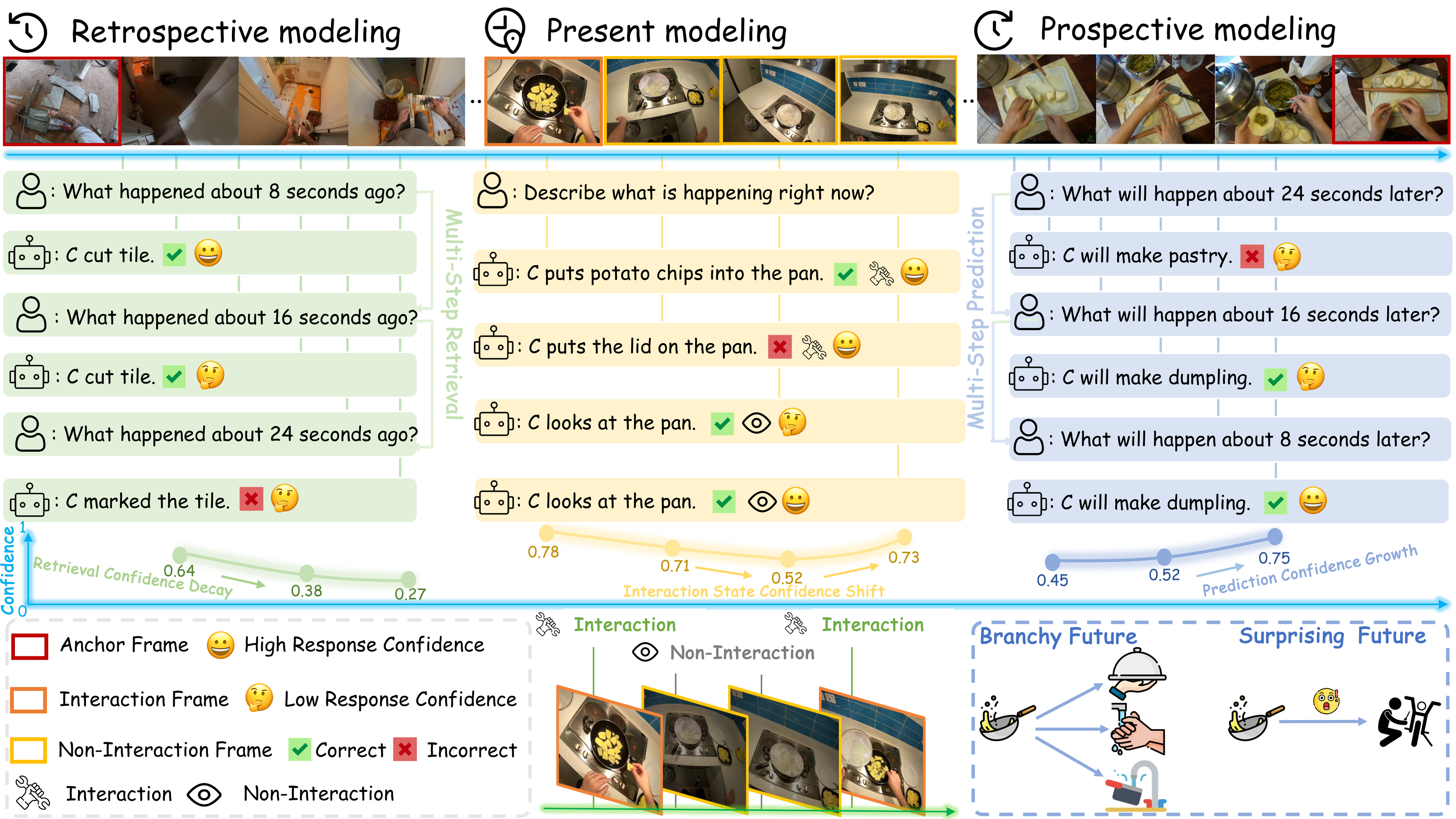
Recent advances in wearable cameras, edge computing, and vision-language models are making first-person AI assistants increasingly practical. In real deployments, such assistants must continuously understand streaming video, respond to the user's current environment, remember relevant past events, and anticipate plausible future interactions.
Existing benchmarks often evaluate video question answering, online narration, and activity anticipation as separate problems. EgoSAT instead uses a unified streaming formulation for egocentric interaction understanding. At each query time, a model can only use video that has already been observed, and it is evaluated on retrospective, present, and prospective reasoning in the same benchmark. EgoSAT also studies whether models can recognize answerability under partial observability and calibrate their confidence when an answer may be uncertain.
The model answers questions about the current observation and identifies visible human-object interaction happening right now.
The model predicts future interactions from the observed video prefix and estimates whether the future is predictable from available evidence.
The model answers questions about past events by locating the relevant moment in the observed streaming history.
EgoSAT is built from Ego4D and provides annotations, multiple-choice candidates, effective querysets, metadata, SFT manifests, and optional ROI cache files for egocentric streaming interaction understanding. Raw Ego4D videos are not redistributed with EgoSAT; users should obtain Ego4D access separately under the corresponding terms.
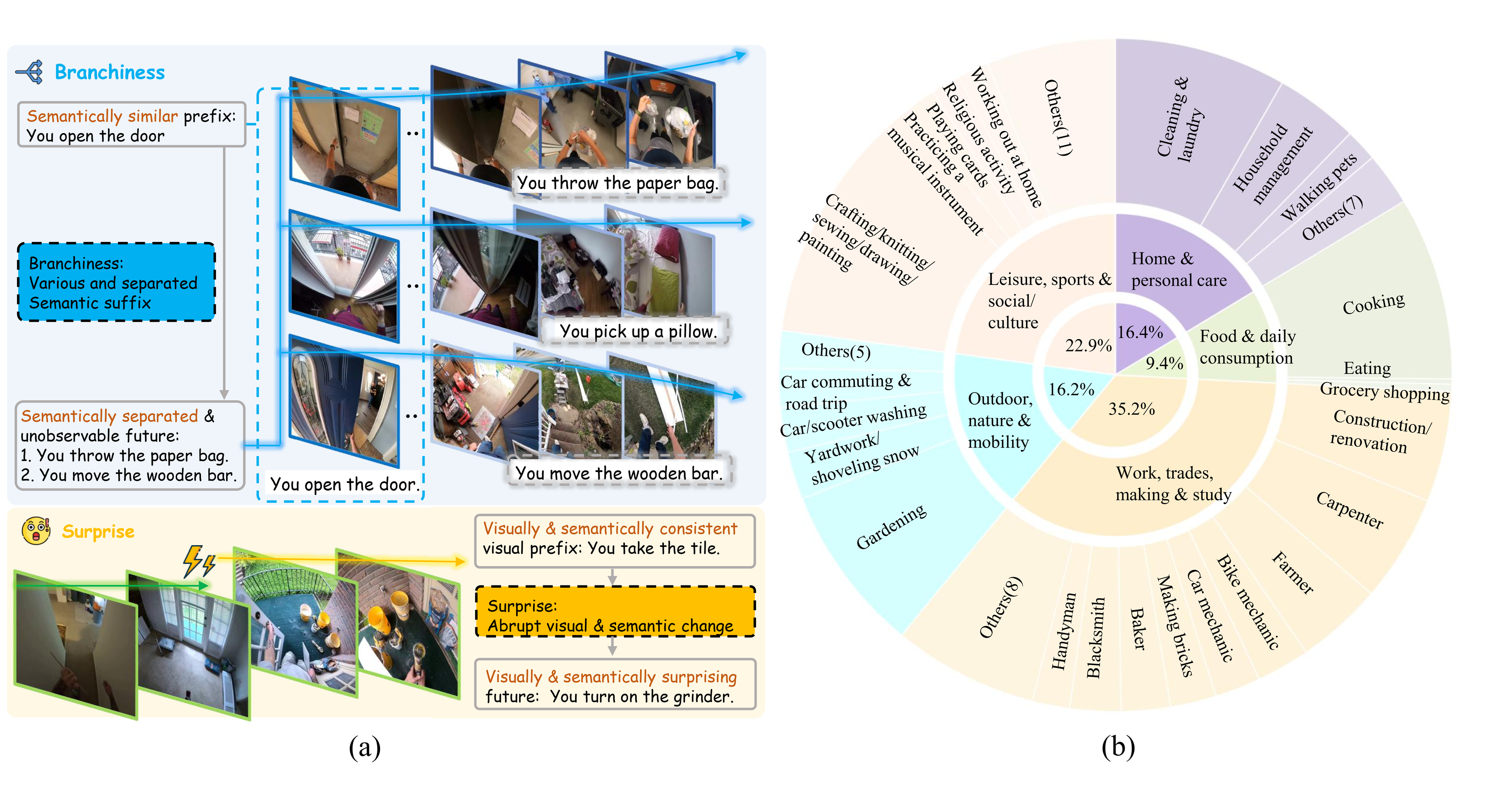
Branchiness. Branchiness captures uncertainty from multiple plausible and semantically diverse future continuations after the same observed interaction prefix.
Surprise. Surprise captures uncertainty from abrupt visual and semantic shifts between the recent observed context and the imminent future event.
EgoSAT separates benchmark annotations from raw videos. Download the EgoSAT annotation release and ROI cache release from Hugging Face, then place local Ego4D videos under your private video root before running video inference.
EgoSAT-data/
  egosat/
    gt/
    mcq_shuffled/
    effective_querysets/
    metadata/
  sft/

EgoSAT-ROI-Cache/
  roi_cache/
  metadata/

Ego4D/
videos/To evaluate a custom model on EgoSAT, implement a model adapter that connects the model to the EgoSAT runner and helper pipeline. An adapter should load video prefixes available before each query time, receive task-specific prompts and querysets, return structured answers, and optionally expose multiple-choice confidence scores for diagnostics.
The official scorer uses raw per-sample prediction JSON files and the released effective querysets. Normalized JSONL files are provided for inspection and downstream convenience, but they are not the official scoring source.
python evaluation/evaluate_main_table.py \
  --pred-root /path/to/predictions \
  --gt-root /path/to/EgoSAT-data/egosat/gt \
  --mcq-root /path/to/EgoSAT-data/egosat/mcq_shuffled \
  --effective-queryset-root /path/to/EgoSAT-data/egosat/effective_querysets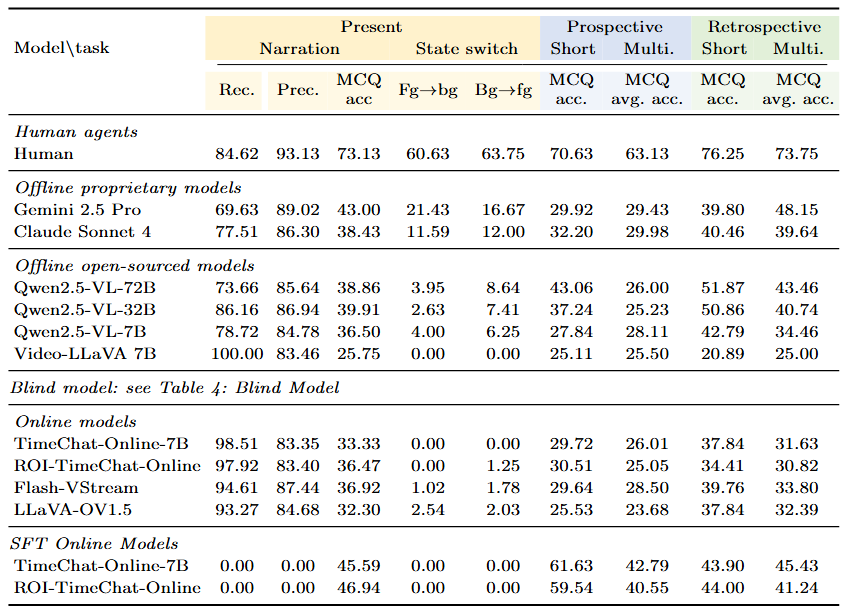
If you find EgoSAT useful for your research, please cite:
@inproceedings{lei2026egosat,
  title={EgoSAT: A Comprehensive Benchmark of Egocentric Streaming Interaction Understanding},
  author={Lei, Yijia and Li, Jinzhao and Zhang, Yichi and Hua, Jiacheng and Li, Yin and Liu, Miao},
  booktitle={European Conference on Computer Vision},
  year={2026}
}Code in this repository is released under the MIT License. EgoSAT annotations, querysets, SFT manifests, and ROI cache are released for research use under the usage terms described in the Hugging Face dataset cards. Raw Ego4D videos are not redistributed and remain governed by the Ego4D license and terms of use.